The Left Fielder

The Left Fielder
Showing posts with label Starlin Castro. Show all posts

Tuesday, May 19, 2015

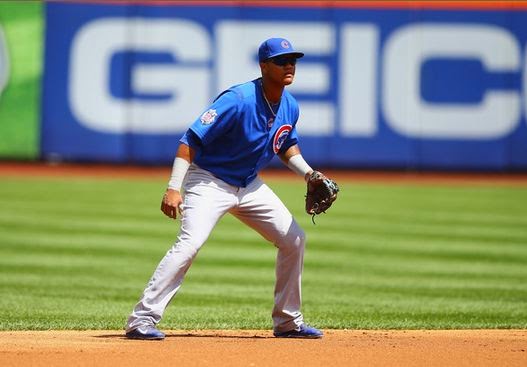
May 20th: A Castro in the Hand...

While the Cubs and Mets clashed in a four game set on the diamond, the front offices spent some time discussing assets and the possibility of a deal being struck. The Cubs are in need of pitching, with a few arms standing between them and a very deep playoff run. Meanwhile, the Mets believe they are a franchise shortstop away from creating a dynasty with dreams of October. Each team is strong in the others’ area of need, and it looks to be a perfect match to make something happen.

“We haven’t made a deal yet, but there’s been matches that made sense, and I’m sure we’ll talk to them in the future,” Cubs General Manager Jed Hoyer said of the conversations with New York. “It’ll happen at some point.”

Today, Bleacher Report took the first crack at guessing what kind of pieces would be included in a blockbuster between the Cubs and Mets. The trade proposed was as follows:

Cubs get: SP Jacob DeGrom, RP Rafael Montero, and C Kevin Plawecki
Mets get: SS Starlin Castro, IF/OF Arismendy Alcantara, and 1B Dan Vogelbach

The argument for the deal is that it is a proven shortstop for a top young arm, with supporting cast members that fill other voids on each team respectively.

The Cubs need to be cautious, though, not to overestimate the value of the infield depth. By trading Castro and Alcantara, they would be losing two of the valuable pieces that contribute to the insane depth of the middle infield. Javier Baez is a valuable piece, but hasn’t proven to be a major contributor at the big league level. Meanwhile, Castro is a centerpiece for what the Cubs have done so far, and has a very team-friendly contract going forward for the next few years.

Right now, the Cubs look like they are about to get to clicking on all cylinders. The infield is a collection of big names, from Bryant to Castro to Russell to Rizzo. That has the makings of a historic squad that can lead the Cubs to a decade of success. To break that up would require an offer that would revolutionize a different facet of the game, and DeGrom just isn’t that.

Rather than using Castro, a veteran presence in the clubhouse, as trade bait, it might better serve the Cubs to use Baez as a high-ceiling gamble for a trade partner. Will this have an impact on the return? Certainly. But it is well worth it to maintain the services of one of the National League’s best shortstops, rather than betting on the development on an offensive monster with strikeout problems.

Another motivation to the trade proposed by BR is the need for the Cubs to find their “Catcher of the Future,” believing that Plawecki could be that backstop. The flaw in this notion is the assumption that Kyle Schwarber doesn’t have a future as a catcher in the league. As a hitter, Schwarber is already begging for his turn at the big league level. Defensively, it seems like the Cubs simply can’t make up their mind. Every few months there is a new article about the hard work he is putting in behind the dish, and how much progress he is making. Then, soon after, we hear that the Cubs are in need of an answer for the future. My money is on Schwarber as a central piece of the Cubs future, and willing to put in the work to make himself invaluable wherever he is needed. It is most certainly not worth it to part ways with Castro to add another name to the mix at a position with a variety of options.

The inclusion of Vogelbach is the one bright spot in this deal. Vogelbach is a strong prospect who has had years of success, but is stuck behind, debatably, the game’s best first baseman for the future. With no real ability to find a different position, the sooner the Cubs can get some return for the hefty first-sacker the better.

On the whole, the Cubs are in a holding pattern with a huge volume of talent at several positions. While they are in need of starting pitching, they should be very thoughtful about giving up a proven star with a team-friendly contract in favor of pitching that might come at too high a price. Waiting to see how the trade market develops in July could be huge for the Cubs to maintain their leadership core while also getting the veteran pitching that will throw them over the edge into a deep playoff threat.

If you enjoy the work of the Zoot Perspective, please visit my GoFundMe page, to help support me on my journey. Thank you very much.

For more content from ZPMedia, visit www.zootperspective.com.

Tuesday, November 18, 2014

November 18th: Cubs Staying the Course

Welcome to the Cubs bandwagon, baseball world. I’ve been here all along, but it’s nice to know that the sports writers across the country are now ready to realize just how good the Cubs could be next season and into the future.

There is plenty of work to be done, though. The starting pitching is weak, the position players are talented but very young and inexperienced, and the free agent market requires a smart mind, rather than a happy trigger finger. Throughout the whole Theo Epstein era, fans have been told that this is a long-term situation and that the Cubs are going to do what it takes to be contenders not for one year, but for many years to come.

Russell Martin just turned the free agency field upside down by forsaking the front-runner Cubs to go for a home-town contract with the Toronto Blue Jays, who were willing to massively overpay for a Canadian star. All of a sudden, a type of panic set in: maybe the Cubs won’t be as much of a player this year in free agency as we thought.

The Cubs did not get into this position as a young, exciting team by making rash decisions and overpaying veterans. As a matter of fact, that’s exactly the situation Theo inherited from a Jim Hendry team that tried to use one free agent signing to fix an overwhelmingly bad team (yes, I’m looking at you Alfonso). I know I’m going to get in trouble for making a Packers reference to Chicago fans, but everyone needs to listen to Aaron Rodgers and “R-E-L-A-X”. One catcher was not the thing standing between the Cubs and a World Series title.

The biggest area where Cubs fans and sports writers are working themselves into a tizzy is with Starlin Castro. The free agent market for shortstops is incredibly thin. The demand is extraordinarily high, though, meaning the Cubs, a team with a stockpile of young middle infielders, could be a huge player. Everyone wants to see Starlin traded for pitching, helping to ease the log-jam, while also adding to the weakest area on the Cubs.

Let’s not get ahead of ourselves, though, folks. Castro is a three-time all-star, returning to form after having a very rough 2013. He is the longest tenured Cub, and has an incredibly team-friendly contract for the next 5 years. While he is a valuable trade chip, the Cubs just might get more value out of him on the team than they would getting rid of him. Castro has the opportunity to be a leader with Anthony Rizzo, the stable core of an otherwise very inexperienced roster. Even with Javier Baez already in the majors and Addison Russell not far behind, the Cubs would rather have a bird in the hand than two in the farm system (not exactly the saying, but ya know).

Another important piece of the puzzle is the possibility for a long-term outlook. If the Cubs can get a catcher, a stud pitcher, and/or a veteran outfielder, they should be in a pretty good place to get started for 2015. Now, if we were to only get one or two of those pieces, we could very well be in position to make a move at the trade deadline. Then, teams will be all the more desperate for a player like Castro, who could be the difference between a division winner and a October couch surfer. By holding on to Castro, the Cubs have the opportunity to see how he develops, and watch the teams line up, willing to blow good long-term talent for short-term wins.

The future looks bright for the Cubs, and it looks bright for many years to come. While some may be tempted to call for $300 million in free agent signings and four or five big trades this offseason, the Cubs need to stay the course. Patience and scouting got the Cubs to where they are now. It would be a terrible time to change the plan.

Thursday, April 10, 2014

What's the Big Deal?

In late March of last year, the Giants locked up catcher Buster Posey on a nine-year, $167 million deal. In May, the Cubs signed Anthony Rizzo to a seven-year deal to go with Starlin Castro’s new contract which had been signed the August before.


For the next year, Major League Baseball saw an influx in signings that showed team locking up promising talent for long-term contracts, in what can only be considered an expensive gamble. The theory was as follows: if we can lock up our future before they start producing like superstars, we can pay them good money without having to pay them great money.


This is, of course, a reaction to the contracts that superstar free agents like Robinson Cano, Josh Hamilton, and Albert Pujols have been getting upon reaching their payday. Teams simply cannot afford to wait until stars pan out, they have to instead get them locked up early.


This is the situation that faces the Angels and Mike Trout. Trout has already proven that he has superstar talent, but he also is under team control for the next few years. Until recently, the Angels seemed content (if not a little disconcerted) to see where things would go. The problem is, though, if Trout continues his dominance, they will have to pay him more than any other player in Major League history. They probably waited one year too long, but got away with what looks like a pretty fair deal for all parties involved in Trout’s new six-year, $144.5 million deal. At the end of the six year deal, Trout would be 29, and still eligible to bring home a contract worth over $300 million.
Mike Trout is already going to make big money, with another significant contract in his future.

Baseball is at a point where the big-time contracts that are being given to the 30 year-old stars have yet to run out. We are still trying to figure out how much bang teams will most likely get for their substantial bucks. Alex Rodriguez, the “inventor” of the mega-deal, is STILL within the contract that he signed that revolutionized the money market in baseball. If he is the standard, then teams should be very concerned about signing the dotted line for these substantial contracts.


What is especially interesting is the types of players that are getting the new mid-level deals. Recently, Matt Carpenter of the Cardinals and Jason Kipnis of the Indians each signed new deals These aren’t the major slammers that get the big deals. These are the regular producers, the grinders, who would get expensive if they were let to hit the free agent market. The Cardinals and Indians basically realized what they had in their system and decided to get them locked up before anyone else could figure it out.


There is, though, the risk of investing highly in a young player who will not pan out. The Cubs are in fear of realizing this with the contracts for Rizzo and Castro. Both signed significant deals prior to (or during) the 2013 season, and proceeded to bust, having terrible years. There is, of course, optimism that the two young studs will turn things around, and that they will lead the Cubs back to the promised land, but there are, of course, risks to signing a pair of 24 year-olds to long-term, big money deals.

The landscape of baseball is changing, and we are standing on the cusp of a financial revolution. Contracts keep getting steeper and steeper, and there will come a time when we can’t get any bigger than the $240 million that Robinson Cano got from the Mariners. To save themselves from having to break the bank later, teams are becoming more interested in signing contract extensions, rather than getting into bidding wars for free agents. Young, exciting, and still growing players are reaping the benefits of these contracts, and have started the revolution in the way teams try to create their foundations for years to come.